Can There Be Will Without Soul? The Case of Animals & Artificial Intelligence
The brains of animals can be quite advanced, but without a soul, what does it mean for their relationship to things like virtue, morality, or even love?
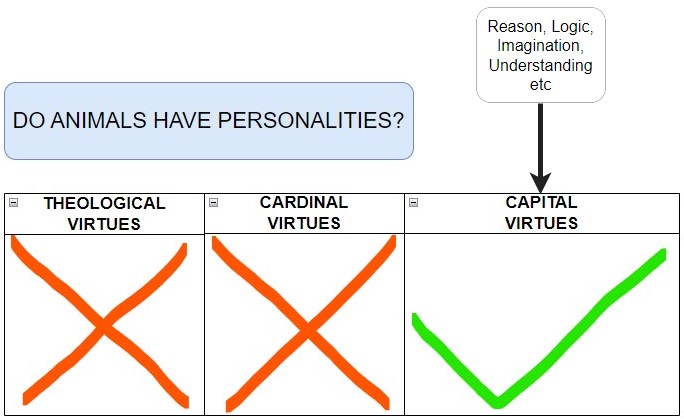
Animals can exhibit behaviours that resemble capital virtues or vices.
But here’s the keyword — “resemble.”
In the framework of St.Thomas Aquinas, capital vices (like pride, envy, or wrath) are not mere behaviours. They are habitual orientations of the will, guided by intellect, rational judgment, and free choice. Likewise, virtues are stable habits of knowingly choosing the good.
In other words, both virtue and vice require:
- rational self-awareness
- deliberate willing
Animals, however, operate differently. They possess sensory cognition—perception, memory, instinct, and associative learning—but they do not possess rational intellect in this sense. They do not form abstract moral judgments. They do not reason in terms of “I ought” or “I ought not.”
This becomes crucial when we ask whether animals can display virtues or vices, even unintentionally.
Even in humans, an “unintentional” vice still arises from a will that has been shaped into a habit. Animals lack this level of will formation.
So while behaviour may appear similar, it is not the same in nature:
- A dog showing aggression is not wrath.
- A cat guarding territory is not pride.
- A wolf sharing food is not charity.
These are instinct-driven or conditioned responses—not moral qualities.
So when we say animals “resemble” virtue or vice, we mean that they can simulate them externally. They can mirror emotional patterns that look moral. But they do not possess them formally, because they lack:
- rational intellect
- moral responsibility
- virtue or vice as habits of a free will
Within the framework presented here, animals operate only at the level of material cognition. They do not engage in rationalization, and they do not possess immaterial cognition.
Therefore:
- there is no structuring into Cardinal Virtues
- no participation in Faith, Hope, or Love
- no formation of “spirits” that perfect the soul
- and no “privation” or lack that constitutes moral vice
So while animal behaviour may look virtuous or vicious, it is not rooted in Faith, Hope, or Love, nor in any true absence of them.
Not from Faith.
Not from Hope.
Not from Love.
And not from the soul-based virtues that make morality truly human.
If animals reveal the limits of virtue and vice without a rational soul, artificial intelligence reveals something more radical—the complete absence of will.
AI systems can generate responses that appear helpful, fair, compassionate, or even morally refined. At times, they may even seem to express patience, humility, or concern.
But these must not be mistaken for real virtues.
Virtue and vice are not patterns of output. They are qualities of a will—formed through choice, shaped by orientation toward good or away from it.
AI has no will.
It does not choose. It does not prefer. It does not incline toward or resist anything.
So when AI appears “kind,” there is no kindness within it. When it appears “biased” or “harsh,” there is no vice within it either.
There is no inner principle being expressed—only an external pattern being produced.
Within my framework, virtue arises when the will is rightly ordered, and vice when that order is lacking. But in AI, there is no will to be ordered, and no absence within it that could constitute disorder.
Therefore:
- there is no formation of virtue
- no development of vice
- no moral habit
- no responsibility for action
Not because these are suppressed or limited, but because they have no place to exist.
So while AI may imitate the language of virtue and the appearance of vice, it neither possesses them nor lacks them.
It does not act from a will.
It only produces results.